

 |
|||||||
|
______________________________________________________________________________________________________________________
|
|||||||

| HOME | |
| SOBRE NóS | |
| ARTISTAS | |
| CONTACTOS | |
áfrica_hoje
 (artigo disponível apenas em inglês)
(artigo disponível apenas em inglês)  
The debate surrounding modern art in Africa has been all the rage both inside Africa and outside the continent from the beginning of the century until the last decade of the XX century. From one coast to the other, words ring out: Black Identity, African Identity, the trap of mimicry, the trap of academism, the trap of the international market, the forced marriage of tradition and modernity, the political desire for social art with a social vocation before and after the independence movement. Mixing
genres is frequent between still living ritual art, popular art,
urban art, recovery art and the art that certain people would like
to call sophisticated.
source: "An Anthology of African Art- the XX century" - N'Goné Fall & Jean Lup Pivin photos: (c) Grimaldi Forum, Monaco
|
||
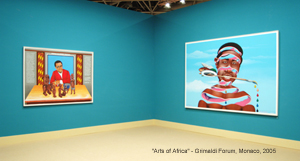 Social
Anthropologists fight with too few art critics to assert a solely
contextual reading. All speeches are good and accompany varied productions
of varied talents. Contempt for artists who are conscious of their
work has long resulted in there being seen as "sexual psychopaths
sacrificed on the altar of acculturation". Attempts have even
been made to portray these artists as merely "bastard"
products of an impossible synthesis between Africa and the West.
People want something that is authentic, true and pure, even if
they have to invent it. Artists wishing to paint, sculpt or produce
as they see fit have been tossed around, knocked down, and mostly
ignored because they only partially participate in the debate from
which they are the first to be excluded. (...)
Social
Anthropologists fight with too few art critics to assert a solely
contextual reading. All speeches are good and accompany varied productions
of varied talents. Contempt for artists who are conscious of their
work has long resulted in there being seen as "sexual psychopaths
sacrificed on the altar of acculturation". Attempts have even
been made to portray these artists as merely "bastard"
products of an impossible synthesis between Africa and the West.
People want something that is authentic, true and pure, even if
they have to invent it. Artists wishing to paint, sculpt or produce
as they see fit have been tossed around, knocked down, and mostly
ignored because they only partially participate in the debate from
which they are the first to be excluded. (...)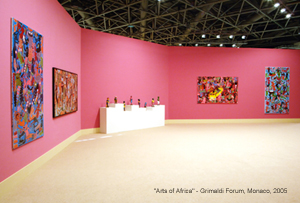 It
is a unit of condition, first and foremost. In all of human memory,
no continent has had a fate quite like Africa's. On the negative
side, this fate is a long succession of hardships, from the slave
trade to colonial domination, to post-colonial abuses. On the positive
side, it is a sort of ongoing success story, in which the continent
constantly gets up after being knocked down, overcomes the gravest
of crisis, each time regaining an autonomy that is unceasingly threatened.
That is why these issues of memory are so important in today's African
communities, as can be seen in it's storybook, film, musical and
of course, scientific production. The message is the same in all
of it's languages: restoring the greatness of "Africa the cradle
of Humanity" and land of notorious empires and glorious heroes.(...)
It
is a unit of condition, first and foremost. In all of human memory,
no continent has had a fate quite like Africa's. On the negative
side, this fate is a long succession of hardships, from the slave
trade to colonial domination, to post-colonial abuses. On the positive
side, it is a sort of ongoing success story, in which the continent
constantly gets up after being knocked down, overcomes the gravest
of crisis, each time regaining an autonomy that is unceasingly threatened.
That is why these issues of memory are so important in today's African
communities, as can be seen in it's storybook, film, musical and
of course, scientific production. The message is the same in all
of it's languages: restoring the greatness of "Africa the cradle
of Humanity" and land of notorious empires and glorious heroes.(...)|
contacte_nos

|
|
AFRICA REMIX - exposição itinerante de arte africana contemporânea DAK'ART - bienal de arte africana contemporânea SAVVY CONTEMPORARY - laboratório de desenvolvimento cultural, conceptual e intelectual The GULBENKIAN FOUNDATION - próximo futuro - programa dedicado à pesquisa e criação na Europa, África, América Latina e Caraíbas NATIONAL MUSEUM OF AFRICAN ART- SMITHSONIAN - museu de arte africana CONTEMPORARY AND - plataforma para a arte internacional de uma perspectiva africana |
|
|
sobre
nós
| áfrica
hoje | artistas
| contactos
| pintura
|fotografia
| escultura
african contemporary - contemporary african art gallery (c) 2013> All rights reserved | privacy policy |